By Haji Satoshi · June 2026
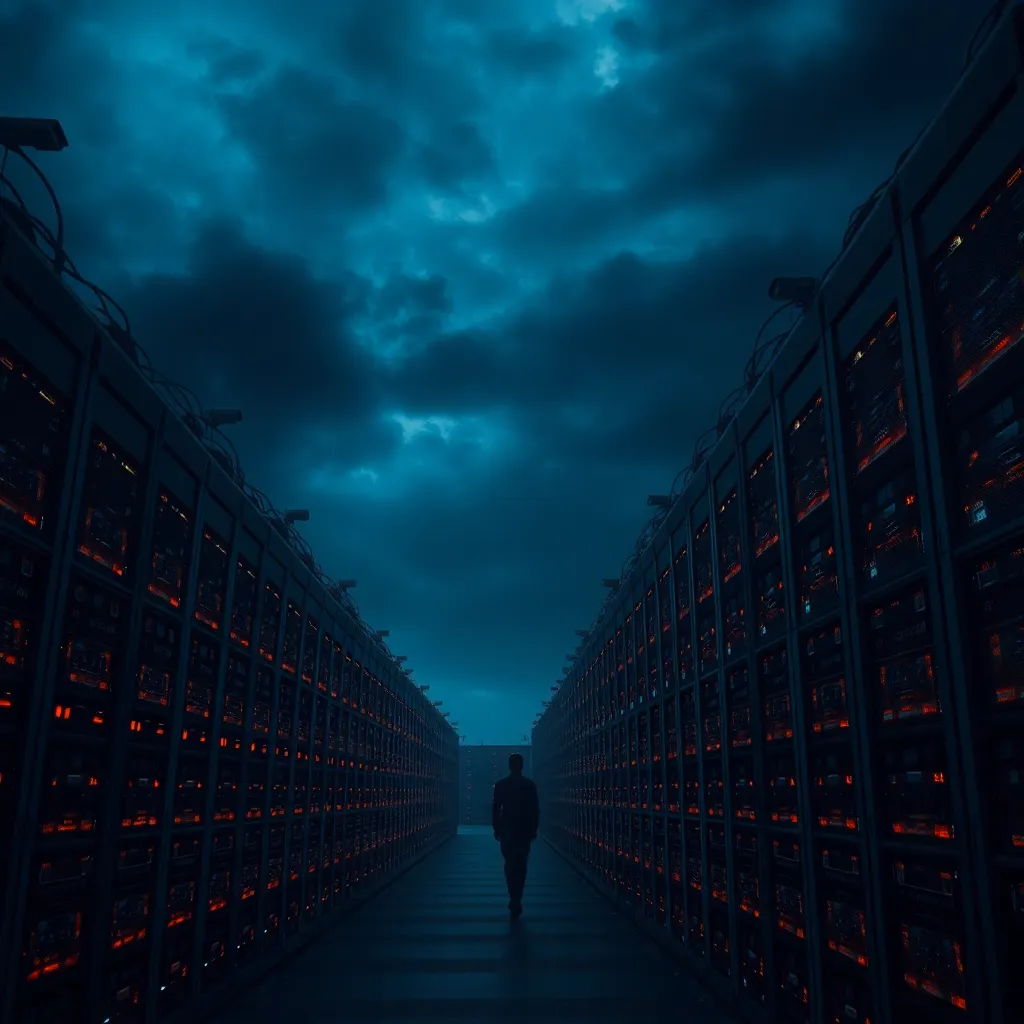
The modern panopticon: data centers are not “the cloud” — they are surveillance nodes. Every query, every transaction, every message flows through infrastructure that can be monitored, throttled, or shut off.
The Story We’re Told
Artificial intelligence will solve climate change. It will cure diseases. It will personalize education, optimize supply chains, and make our lives easier. The benevolent assistant. The helpful machine.
This story is so appealing that we forget to ask the most basic question: Who controls it, and what do they want?
In 1985 — forty years before the current AI hype — cryptographer David Chaum wrote a paper called “Security Without Identification: Card Computers to Make Big Brother Obsolete.” He described a world where:
“Even a small group using pattern recognition techniques and tapping into data gathered in everyday consumer transactions could secretly conduct mass surveillance, inferring individuals’ lifestyles, activities, and associations.”
He wrote this before the internet existed as we know it. Before smartphones. Before social media. Before data centers. And he was describing exactly what’s happening today.
The AI narrative is a misdirection. The real purpose of AI is not human flourishing — it’s resource control, population management, and the elimination of dissent.
What AI Actually Is
Let’s be precise about what “artificial intelligence” actually is in 2026.
It is not intelligence. It is pattern recognition at scale, trained on the largest corpus of human behavioral data ever assembled. The output is prediction and classification:
- Who is valuable to the system
- Who is risky to the system
- Who can be influenced
- Who needs to be contained
This is not a conspiracy theory. It is the logical architecture of any system designed to process data about human behavior at scale. The AI doesn’t need to “want” control — the system that deploys it naturally selects for control because control is what the system is optimized for.
Timothy C. May — founder of the Cypherpunks — wrote in his Cyphernomicon (1994):
“Surveillance vs. Freedom. Nothing in the middle. Either strong crypto and privacy is strongly limited, or the things I describe here will be done by some people. The tipping factor applies — point of no return, horses out of the barn.”
May understood something fundamental: the choice between surveillance and freedom is binary. There is no “balanced approach.” You either build systems that make you legible to power, or you build systems that make you invisible. The middle ground is an illusion.
The Real Purpose of Data Centers
We call it “the cloud” because that sounds benign. Soft. Ethereal. But the cloud is made of concrete, steel, and silicon — massive facilities consuming enormous amounts of electricity, water, and land.
Why so much infrastructure? Because control requires infrastructure.
Every search query, every transaction, every message, every “Hey Siri” flows through hardware that can be:
- Monitored — logged, analyzed, correlated
- Throttled — slowed down or deprioritized
- Shut off — denied access entirely
This is not speculation. Edward Snowden showed us the architecture in 2013. The NSA’s data centers in Utah and Maryland were built for exactly this purpose: intercepting, storing, and analyzing communications at planetary scale.
The AI data centers being built today are the next generation. They don’t just store your data — they understand it. They build models of who you are, what you want, and what you might do. And those models are available to whoever controls the infrastructure.
David Chaum saw this coming in 1985:
“Computerization is robbing individuals of the ability to monitor and control the ways information about them is used. Already, public and private sector organizations acquire extensive personal information and exchange it amongst themselves. Individuals have no way of knowing if this information is inaccurate, outdated, or inappropriate.”
Replace “computerization” with “AI” and you have a perfect description of 2026.

In 1994, Timothy May wrote: “Crypto = guns in the sense of being an individual’s preemptive protection.” Privacy is not about hiding — it’s about defending yourself against systems that would otherwise know everything about you.
The Elite Pre-Positioning
Here is where we move from technical architecture to human intention.
Large institutions — governments, corporations, central banks — are not surprised by AI. They have been preparing for it. Building the legal frameworks, the technical infrastructure, the social acceptance. Why?
Because AI gives them something they have always wanted: legibility.
A population that is fully legible is a population that is fully manageable. When the system knows everything about you — your spending, your movements, your relationships, your thoughts — it can predict and influence your behavior with precision.
This is not new. The modern state has always sought legibility. James C. Scott’s Seeing Like a State documents how governments throughout history have tried to make their citizens readable — through censuses, ID systems, standardized measurements, and centralized records.
AI is simply the ultimate legibility tool. And it’s being deployed now because the infrastructure is finally ready:
- Data: Decades of digital exhaust — every email, every purchase, every search
- Compute: GPU clusters powerful enough to process it all
- Storage: Cheap enough to keep everything forever
- Networks: Fast enough to access it in real-time
- Legal: Frameworks like CBDCs and digital ID that formalize the system
The “green transition” and “smart cities” are often the same grid with better branding. Sensors in every streetlight. Cameras on every corner. Digital wallets that track every transaction. All in the name of efficiency, safety, sustainability.
David D. Friedman, in The Case for Privacy (2005), framed it with a science fiction story. Poul Anderson’s novel features a device that surrounds its bearer with an impenetrable force shield. The hero realizes the right question is not “who can be trusted with this power” but “how does this tool change the balance between freedom and oppression”?
His answer: “A world where the random individual is armored against anything short of an atomic explosion will be, on net, a better and freer world.”
That is what freedom tech is building. Right now. Today.
Why Bitcoin Is the Exit
Bitcoin is often described as “digital gold” or “a store of value.” But that undersells it. Bitcoin is the first monetary system designed to be resistant to the control grid.
Here is what that means in practice:
No central data center to surveil. Bitcoin runs on thousands of nodes distributed across the globe. There is no single point of control. You can’t shut it down by raiding a data center. You can’t freeze someone’s Bitcoin by calling a bank.
No behavioral profiling. Bitcoin is pseudonymous. Your identity is not linked to your wallet. The system doesn’t know your name, your location, your spending habits, or your social graph. It only knows your public key — a string of characters that reveals nothing about you.
Proof-of-work ties security to physical energy, not digital control. Bitcoin’s security comes from real-world energy expenditure (mining), not from the authority of a government or corporation. This means it cannot be inflated away by decree or shut down by regulatory fiat.
Peer-to-peer, no gatekeeper. You don’t need permission to create a wallet. You don’t need KYC to receive Bitcoin. You don’t need a bank account to participate. The network doesn’t care who you are — only that your transaction is valid.
Timothy May wrote in the Cyphernomicon:
“Governments essentially cannot stop most of these approaches, short of establishing a police state (and probably not even then).”
He was right. Despite fifteen years of attempts — bans, regulations, KYC mandates, exchange crackdowns — Bitcoin continues to exist, to grow, to be used. Because it is designed to survive exactly the kind of pressure the control grid applies.

The exit is not a metaphor. Bitcoin, Lightning, Cashu, and Nostr are real tools that work right now. You don’t need permission to use them. You don’t need to trust anyone to operate them.
Freedom Tech as Counter-Architecture
Bitcoin is the foundation. But the control grid targets every layer of the financial system. So the freedom tech stack extends:
Lightning Network
- What it does: Instant, cheap Bitcoin payments
- Why it matters: No bank can block or reverse a Lightning payment. No KYC required. No “risk score” can deny you access. Lightning is Bitcoin’s layer-2 — it makes Bitcoin practical for everyday payments while inheriting all of Bitcoin’s censorship resistance.
- Go further with LNbits: LNbits is a self-hosted Lightning wallet management system that turns your node into a full financial platform — multi-wallet support, pay links, shop extensions, ticketing, and more. Centralized LN custodians (like Wallet of Satoshi) can be pressured to freeze accounts or collect KYC. With LNbits, you run your own infrastructure. No third party can freeze your funds or deny you service.
- Control grid counter: The traditional payment system (Visa, SWIFT, FedNow) is fully surveilled and controllable. Lightning is neither.
Cashu
- What it does: Chaumian ecash — private, anonymous tokens that settle over Lightning
- Why it matters: Cashu transactions leave no public trace. There is no transaction graph to analyze. No history to subpoena.
- Control grid counter: Every traditional digital payment creates a permanent record. Cashu creates cash-like privacy on top of Bitcoin’s settlement.
Nostr
- What it does: Decentralized social communication. No platform. No algorithm. No censorship.
- Why it matters: Your identity, your messages, your followers — none of it can be taken away by a platform deciding you violated their terms.
- Control grid counter: Every major social platform (X, Facebook, YouTube) is a surveillance node. Your social graph is mapped, your speech is moderated, your reach is algorithmically controlled. Nostr has none of this.
VPNs and Mesh Networks
- What they do: VPNs encrypt your traffic and route it through remote servers, hiding your activity from your ISP and local network. Mesh networks (like Briar, Yggdrasil, or local wireless meshes) create local communication networks with no central infrastructure at all.
- Why they matter: Tor is powerful but slow, vulnerable to correlation attacks (when an adversary controls both your entry and exit), and increasingly blocked by services. VPNs offer better speed and practicality for daily use. Mesh networks offer communication that works even when the internet is down or censored — essential during the “Grand Transition” scenarios where centralized infrastructure fails.
- Control grid counter: The control grid depends on surveillance at the network level (ISP logging, DNS monitoring, traffic analysis). VPNs break the ISP logging link. Mesh networks break the centralized infrastructure dependency entirely.

Human consciousness develops in stages — each one solving problems the previous couldn’t see. The control grid thrives on trust and efficiency. The exit demands something different: systemic thinking, self-sovereignty, building parallel systems you can verify rather than trust.
The Consciousness Question
Why do people fall for the AI narrative? Why do we accept surveillance in exchange for convenience?
Part of the answer lies in how human consciousness develops. We move through stages of understanding — each one solving problems the previous couldn’t see, but also blind to new dangers.
Early stages trust authority. “The government knows best. If AI keeps us safe, let them use it.” The next stage embraces efficiency and progress. “It’s the future. I want the best tools.” Then comes the communal stage: “It’s inclusive. It will help everyone.”
These stages are where the control grid thrives — on trust, on efficiency, on the belief that the people in charge have our best interests at heart.
But there’s a shift that happens when someone starts asking uncomfortable questions: Who actually controls this? What happens when this power is misused? What’s the systemic effect, not just the promised benefit? That’s when you start seeing the grid for what it is. You stop trusting and start verifying. You stop depending and start building.
David D. Friedman, in The Case for Privacy (2005), framed it with a science fiction story. Poul Anderson’s novel features a device that surrounds its bearer with an impenetrable force shield. The hero realizes the right question is not “who can be trusted with this power” but “how does this tool change the balance between freedom and oppression”?
His answer: “A world where the random individual is armored against anything short of an atomic explosion will be, on net, a better and freer world.”
Privacy is not about hiding from the law. It’s about protecting yourself from a system that would otherwise know everything about you. The question is not “if you have nothing to hide, what do you have to fear?” The question is: “If someone knew everything about you, what could they do with that knowledge?”
The answer, in 2026, is: everything.
The Grand Transition
Systems theorist Simone Michelson calls what’s happening “The Grand Transition” — a discontinuity in civilization driven by resource fragility, supply chain vulnerability, and the collapse of just-in-time systems.
She points out that semiconductors are the modern equivalent of charcoal in ancient metallurgy. If you lose the ability to make semiconductors, all technology goes offline. Most regions cannot reconstitute that capability. The unraveling has already begun.
Her conclusion: “We’re going to be forced into a local, regional, decentralized system whether you like it or not.”
Bitcoin and freedom tech are the voluntary version of this transition. Instead of waiting for the centralized system to collapse and being forced into chaos, you build your own systems now. You exit the control grid before it becomes a prison.
Timothy May wrote in 1994:
“We are at a fork in the road. The tipping factor applies.”
Thirty years later, the fork is behind us. The horses are out of the barn. The control grid is being built. The question is no longer whether this transition is happening — it’s whether you are building your own exit or waiting for the grid to close around you.
Build, Don’t Wait
The tools exist today. They work today. They are not theoretical.
You don’t need to understand the cryptography. You don’t need to be a programmer. You don’t need anyone’s permission.
Start with one thing:
- Self-custody some sats — Download a wallet (BlueWallet, Muun, Phoenix). Write down your seed phrase on paper. Buy $20 worth. You now have Bitcoin that no one can freeze.
- Run a Lightning node — Phoenix or Muun do this automatically. You can send and receive Bitcoin instantly, privately, without permission.
- Use Cashu — A Cashu mint gives you anonymous tokens. Spend them anywhere. Leave no trace.
- Use Nostr — Download Amethyst or Primal. Create an account. Your identity belongs to you, not a platform.
- Use a VPN and Mesh Networks — A VPN encrypts your traffic so your ISP can’t log what you’re doing. Mesh networks (Briar, Yggdrasil) let you communicate even when the internet is down or censored. Together they break the network-level surveillance the control grid depends on.
Each of these tools addresses a specific failure mode of the control grid. Together, they form a complete parallel financial and communication infrastructure.
If you’re new here, start with the 10-part Bitcoin series — it’s a full primer from first principles to self-custody, Lightning, and self-sovereignty. Not just education. Preparation.
David Chaum saw this in 1985. Timothy May predicted it in 1994. Satoshi Nakamoto built the foundation in 2009. Now it’s your turn to use it.
The control grid is real. The surveillance is real. The AI is not your friend.
But the exit is also real. And it’s open.
“The root problem with conventional currency is all the trust that’s required to make it work.” — Satoshi Nakamoto
“Crypto = guns in the sense of being an individual’s preemptive protection.” — Timothy C. May, 1994
“Computerization is robbing individuals of the ability to monitor and control the ways information about them is used.” — David Chaum, 1985
Further Reading:
- The Cyphernomicon — Timothy C. May
- The Case for Privacy — David D. Friedman
- Security Without Identification — David Chaum
- Bitcoin is Digital Scarcity
If this resonated with you, share it with someone who’s starting to sense something is wrong but hasn’t connected the dots yet. The exit is open. The tools work. Start today.